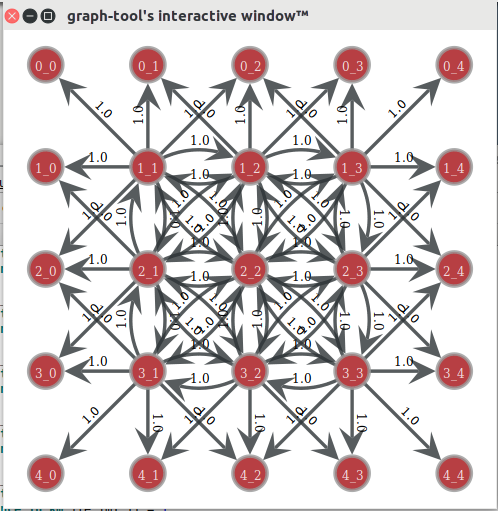
Tiago, I start to believe that the error is not related to the size of the graph but rather to the epsilon parameter that is passed to the function all_shortest_paths(). Based on the documentation the epsilon parameter is defined as "Maximum relative difference between distances to be considered equal". I want to compute not only the best path but also paths that are "fairly" close to the best one, so I set epsilon=5 to have the function return multiple "best paths". This messes up the function it either creates a segmentation error, or it crashes the whole virtual machine. The following code creates a 5x5 graph where each edge that does not lie to the periphery of the square is connected to all neighboring edges with a weight of 1. The best path from vertex "3_1" to "1_2" is obvious the diagonal path which has a weight of 2. I was expecting that by setting epsilon=5, other paths would also be returned, for example (3_1, 3_2, 2_2, 1_2) that has weight of 4. Instead, the function crashes and returns the following error: Traceback (most recent call last): File "<input>", line 3, in <module> File "/home/labuser/anaconda3/envs/py35/lib/python3.5/site-packages/graph_tool/topology/__init__.py", line 1978, in all_shortest_paths _prop("v", g, all_preds_map)) MemoryError I probably misuse the epsilon parameter, but is there a way to achieve what I described above? The source code that recreates the problem can be found at the end of the email. I am using version 2.26 on an Ubuntu 17.10 virtual machine. Thanks in advance for the help, Vaggelis [image: Inline image 2] import gi import numpy as np gi.require_version('Gtk', '3.0') from graph_tool.all import * import graph_tool as gt from graph_tool.topology import * import tqdm import math g = gt.Graph(directed=True) dict_v_name_to_v = {} g.vertex_properties["name"] = g.new_vertex_property("string") g.vertex_properties["pos"] = g.new_vertex_property("vector<float>") g.edge_properties["name"] = g.new_edge_property("string") # name of edge, if any comes from csf g.edge_properties["text"] = g.new_edge_property("string") # name of edge, if any comes from csf g.edge_properties["elev_gain"] = g.new_edge_property("double") # name of edge, if any comes from csf vp = g.vertex_properties ep = g.edge_properties N_LON=5 N_LAT=5 # Vertices print("\r\nCreating Vertices") for i in range(0, N_LAT): for j in range(0, N_LON): v = g.add_vertex() v_name = str(i) + '_' + str(j) dict_v_name_to_v[v_name] = v vp["name"][v] = v_name vp['pos'][v] = [float(j), float(i)] # Edges print("\r\nCreating Edges") for j in range(1, N_LON - 1): # long jm1 = j - 1 jp1 = j + 1 for i in range(1, N_LAT - 1): # lat ip1 = i + 1 im1 = i - 1 im1_s, i_s, ip1_s = [str(el) for el in (im1, i, ip1)] jm1_s, j_s, jp1_s = [str(el) for el in (jm1, j, jp1)] v_i_jm1 = dict_v_name_to_v['_'.join([i_s, jm1_s])] v_i_j = dict_v_name_to_v['_'.join([i_s, j_s])] v_i_jp1 = dict_v_name_to_v['_'.join([i_s, jp1_s])] v_ip1_jm1 = dict_v_name_to_v['_'.join([ip1_s, jm1_s])] v_ip1_j = dict_v_name_to_v['_'.join([ip1_s, j_s])] v_ip1_jp1 = dict_v_name_to_v['_'.join([ip1_s, jp1_s])] v_im1_jm1 = dict_v_name_to_v['_'.join([im1_s, jm1_s])] v_im1_j = dict_v_name_to_v['_'.join([im1_s, j_s])] v_im1_jp1 = dict_v_name_to_v['_'.join([im1_s, jp1_s])] e_i_jm1 = g.add_edge(v_i_j, v_i_jm1) e_i_jp1 = g.add_edge(v_i_j, v_i_jp1) e_ip1_jm1 = g.add_edge(v_i_j, v_ip1_jm1) e_ip1_j = g.add_edge(v_i_j, v_ip1_j) e_ip1_jp1 = g.add_edge(v_i_j, v_ip1_jp1) e_im1_jm1 = g.add_edge(v_i_j, v_im1_jm1) e_im1_j = g.add_edge(v_i_j, v_im1_j) e_im1_jp1 = g.add_edge(v_i_j, v_im1_jp1) ep["elev_gain"].a = 1 for e in g.edges(): ep["text"][e] = str(ep["elev_gain"][e]) # name of edge, if any comes from csf graph_draw(g, pos=g.vertex_properties['pos'], vertex_text=g.vertex_properties["name"], edge_text=ep["text"], update_layout=False) v_start = dict_v_name_to_v['3_1'] v_dest = dict_v_name_to_v['1_3'] ############################# # epsilon=0.0005 WORKS FINE ############################# all_paths = all_shortest_paths(g, v_start, v_dest, weights=ep["elev_gain"], epsilon=.0005) print(list(all_paths)) ############################# # epsilon=5 CRASHES ############################# all_paths = all_shortest_paths(g, v_start, v_dest, weights=ep["elev_gain"], epsilon=5) print(list(all_paths)) On Wed, Jan 17, 2018 at 9:07 PM, Tiago de Paula Peixoto <tiago@skewed.de> wrote:
On 18.01.2018 06:05, Evangelos Petsalis wrote:
I understand that it returns an iterator, but I assume it still does some preparatory work internally that potentially allocates memory. I don't do any list conversion. I simply call the function without even assigning the output to any local variable.
The error message I get is as follow:
Traceback (most recent call last): File "/usr/local/lib/python3.5/dist-packages/IPython/core/ interactiveshell.py", line 2862, in run_code exec(code_obj, self.user_global_ns, self.user_ns) File "<ipython-input-3-07c125e74096>", line 1, in <module> all_shortest_paths(g, v_start, v_dest, ep["sp_weight"], epsilon=10) File "/usr/lib/python3/dist-packages/graph_tool/topology/__init__.py", line 1978, in all_shortest_paths _prop("v", g, all_preds_map)) MemoryError
As usual, without a minimal and self-contained (i.e. complete) example that shows the problem, it is not possible to say anything. An error message without any context is not very useful.
-- Tiago de Paula Peixoto <tiago@skewed.de>
_______________________________________________ graph-tool mailing list graph-tool@skewed.de https://lists.skewed.de/mailman/listinfo/graph-tool